The transition between Albury's granite-derived residual soils and Wodonga's deep Murray River alluvium creates two distinct ground conditions within the same urban area. In the floodplain sectors near the river, soft clay layers up to eight metres thick demand careful ground improvement before any significant load can be applied. That is where deep soil mixing design becomes the preferred solution, because it treats the problematic strata in situ without excavating and replacing. Before specifying the binder dosage and column layout, we always run a detailed laboratory classification on the site soil to understand the clay mineralogy and natural moisture content — both factors that heavily influence the final DSM strength.
A slag replacement ratio around 50% reduces heat of hydration and improves long-term strength gain in the alluvial clays of Albury-Wodonga.
Methodology and scope
Local considerations
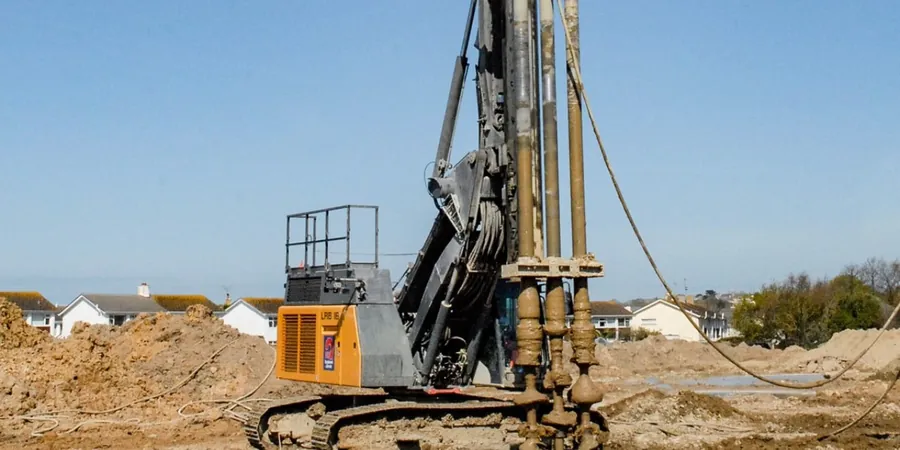
The DSM rig itself is the most telling sign of project complexity — when we mobilise a 50-tonne track-mounted machine in Albury-Wodonga, it usually means the soft layer extends deeper than six metres. The rotating mixing tool advances while injecting binder slurry, and the operator must control both penetration rate and rotation speed to ensure homogeneous blending. If the spoil returns show un-mixed clay lenses, we stop and adjust. The main risk is incomplete mixing along the column perimeter, which creates weak zones that can compromise the entire treated block. That is why we follow AS 4678 for quality control, taking one wet-grab sample at every 1.5 m of depth and verifying the final columns with coring after 28 days.
Applicable standards
AS 4678 – Earth-retaining structures, AS 1726 – Geotechnical site investigations, AS/NZS 1170 – Structural design actions
Associated technical services
DSM Design for Embankment Support
For road and railway embankments over soft alluvium, we design a grid of DSM columns arranged to reduce total and differential settlements to acceptable levels. The service includes laboratory mix design, finite-element settlement analysis, and a construction specification covering binder type, dosage, and acceptance criteria.
DSM Design for Excavation Support
When temporary or permanent excavation support is needed near the Murray River floodplain, DSM panels can be designed as in situ gravity walls or buttress elements. We calculate the required panel thickness and embedment depth using limit-equilibrium methods, and we provide QA/QC protocols that align with the NATA-accredited laboratory procedures.
Typical parameters
Frequently asked questions
How deep can deep soil mixing columns reach in Albury-Wodonga?
Most projects in Albury-Wodonga treat depths between 5 and 15 metres, but columns can reach up to 25 metres using larger rigs. The practical limit depends on the drilling torque available and the presence of gravel layers within the alluvium.
What is the typical strength gain of DSM columns in local clays?
With a cement-slag binder at 200 kg/m³, the 28-day unconfined compressive strength typically ranges from 0.8 to 1.5 MPa in the Albury-Wodonga alluvial clays. Higher dosages can push that to 2.0 MPa, but we always verify with site-specific mix trials.
How much does deep soil mixing design cost in Albury-Wodonga?
The design and laboratory component typically falls between AU$2.710 and AU$9.190 depending on the number of mix trials and the complexity of the settlement analysis. The final cost also reflects the volume of treated soil and the access conditions on your site.