The Murray River floodplain gives Albury-Wodonga a distinct subsurface. We see deep clay layers with high plasticity, especially near the river terraces. These clays undergo significant volume change with moisture shifts. Settlement analysis in Albury-Wodonga must account for that. The water table sits shallow in many suburbs, sometimes at 2 meters depth. That adds consolidation risk. Before any footing design, we run oedometer tests on undisturbed samples. For sites with suspected organic soils, we combine this with a classification of soils to identify problematic layers early. That step saves clients from costly foundation repairs later.
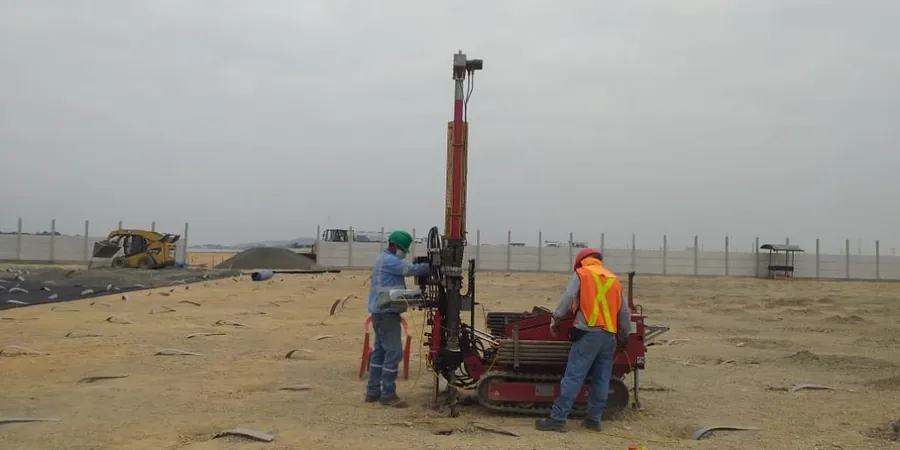
Deep clay layers near the Murray floodplain can settle up to 40 mm over five years if pre-consolidation pressure is misjudged.
Methodology and scope
Local considerations
Albury-Wodonga sits in a temperate zone with dry summers and wet winters. The seasonal moisture cycle drives cyclic swelling and shrinking in the clay profile. That creates differential movement under strip footings. The biggest risk is underestimating the depth of active zone. We have measured active zones down to 2.5 meters in parts of Lavington. A settlement analysis that ignores this seasonal shift will underpredict long-term movement. Combine that with a shallow water table, and you get consolidation from building load plus volume change from climate. That dual mechanism causes most of the local foundation distress we see.
Applicable standards
AS 1289.6.6.1 (One-Dimensional Consolidation Test), AS 1726 (Geotechnical Site Investigation), AS 2870 (Residential Slabs and Footings)
Associated technical services
Consolidation Test Suite
Full oedometer testing with incremental loading up to 1600 kPa. Includes determination of Cc, Cr, Cv, and Pc. Suitable for clay sites on the floodplain.
Settlement Prediction Report
Numerical analysis using Boussinesq and Terzaghi methods. Provides total and differential settlement estimates for shallow foundations, mat slabs, and embankments.
Monitoring with Settlement Plates
Field installation of vibrating wire settlement cells and optical survey points. Weekly readings during construction to validate predictions and trigger remediation if needed.
Pre-construction Soil Survey
Site investigation with boreholes, undisturbed sampling, and in-situ moisture profiling. Results feed directly into the settlement model and foundation design recommendations.
Typical parameters
Frequently asked questions
How much does a settlement analysis cost in Albury-Wodonga?
A standard consolidation test suite with a settlement prediction report typically ranges between AU$1,010 and AU$2,920. The final price depends on sample quantity, required depth, and whether field monitoring is included.
What soil types cause the most settlement problems here?
The high-plasticity clays of the Murray River floodplain are the main culprit. They have Cc values above 0.4 and can show significant secondary compression. Organic silts near creeks also cause consolidation issues.
How long does a full oedometer test take?
A standard multi-stage test runs 5 to 7 days. Each load increment stays for 24 hours. For projects with tight timelines, we offer a 24-hour rapid test using the Casagrande log-time method, but accuracy drops slightly.
Do I need settlement analysis for a single residential slab?
For a house slab on reactive clay in Albury-Wodonga, yes. AS 2870 requires site classification based on soil reactivity. A settlement analysis gives you the actual movement magnitude, not just a classification. It justifies deeper footings or stiffened raft design.
What is the difference between total and differential settlement?
Total settlement is how much the entire foundation sinks. Differential settlement is the uneven movement between two points. A 20 mm total settlement is fine, but 15 mm differential across a 6-meter span can crack walls. We always report both.