A recent multi-storey development along Dean Street in Albury-Wodonga required reliable undrained shear strength data for the soft alluvial clays underlying the site. The field vane shear test (VST) was selected over lab methods because it measures the in-situ strength without disturbing the sensitive clay fabric. For deeper profiles, we also ran a dilatometer test to cross-check stiffness parameters. The VST results directly fed into the bearing capacity and settlement calculations under AS 4678.
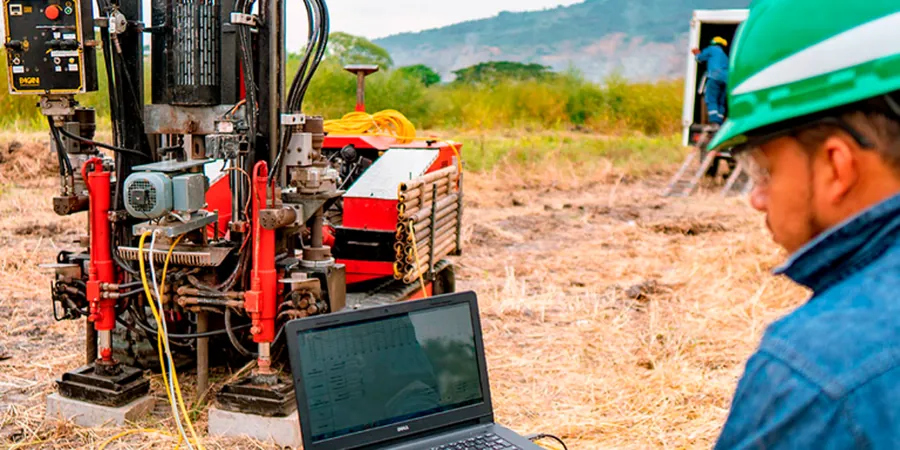
The field vane shear test (VST) remains the most direct method for measuring undrained shear strength in soft clays, especially in floodplain deposits like those of Albury-Wodonga.
Methodology and scope
Local considerations
The main risk in Albury-Wodonga is underestimating the sensitivity of the soft clays. Vane shear tests (VST) reveal that remoulded strength can drop below 10 kPa in some pockets, leading to progressive failure if not accounted for in slope or embankment design. Seasonal groundwater fluctuations from the Murray River also affect the clay's water content and peak strength. Running VSTs during both wet and dry periods gives a realistic strength envelope for long-term stability.
Applicable standards
AS 1726:2017 Geotechnical site investigations, AS 1289.6.2.1 Standard Test Method for Field Vane Shear Test, AS 4678:2002 Earth-retaining structures (bearing capacity clause)
Associated technical services
Standard VST – Soft Soil Profiling
Up to 8 vane tests per location at 1.5 m depth intervals. Includes peak and remoulded torque, sensitivity calculation, and a field plot of Su vs depth. Suitable for embankments, road upgrades, and low-rise foundations on floodplain deposits. Delivered with an AS 1726 compliant test report.
Advanced VST – Critical Design Input
Extended testing with multiple vane sizes (H/D = 1:1, 2:1) to assess anisotropy. Includes pore pressure dissipation monitoring during vane insertion. Designed for high-rise piles, bridge abutments, or slope stability analyses where strength variation with direction matters. Report includes interpreted Su, St, and correction factors for Bjerrum.
Typical parameters
Frequently asked questions
How does the field vane shear test (VST) differ from a laboratory triaxial test?
The VST measures undrained shear strength in place, preserving the natural soil fabric and stress state. Lab triaxial tests require undisturbed sampling, which can disturb soft clays and alter results. For Albury-Wodonga's sensitive alluvial clays, VST often gives more conservative and realistic Su values.
What is the typical cost range for a VST campaign in Albury-Wodonga?
A standard VST campaign for a small site (6–8 tests) typically falls between AU$910 and AU$2,450, including mobilisation, testing, and a basic report. Larger projects with advanced anisotropy testing or deeper borings may cost more. Contact us for a site-specific quote.
Can VST be performed in gravelly or sandy soils?
No. The vane test is designed for cohesive soils (clay, silt, organic clay) where the vane can shear the soil without encountering gravel or sand particles. If the Albury-Wodonga site has sandy layers, we recommend complementing VST with CPT or SPT for those strata.
How long does a VST take per test depth?
Each test depth typically takes 15–20 minutes: 2–3 min to advance the vane, 5–8 min for the peak rotation, and 5–10 min for the remoulded cycle. With setup and moving between locations, a full day on site yields 5–8 tests.
Do you provide NATA-accredited VST results?
Yes. Our laboratory holds NATA accreditation for field vane shear testing under AS 1726. The test report includes torque calibration certificates, vane geometry verification, and signed results by a chartered professional engineer.