Albury-Wodonga sits at around 165 metres above sea level, with the Murray River cutting through the region. The alluvial plains and floodplain deposits create variable soil profiles, many with moderate to high clay content. These clays are reactive: they shrink when dry and swell when wet. For any foundation work here, expansive soil evaluation is not optional — it is the first step to avoid structural cracking. We combine field sampling with laboratory testing to classify plasticity and volume change potential. Before pouring concrete we recommend a drainage geotechnical study to manage water infiltration around footings, and a soil classification to confirm the USCS group. Our team has handled dozens of sites in Albury-Wodonga, so we know the local soil behaviour first-hand.
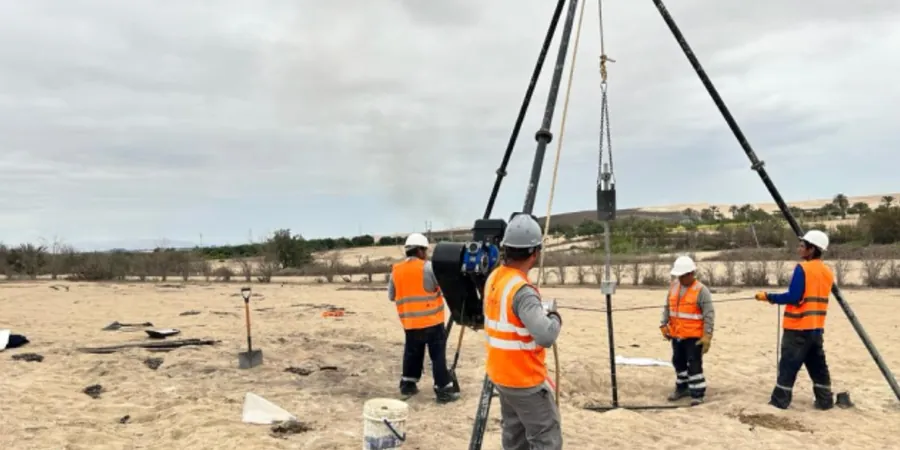
Reactive clays in Albury-Wodonga can move up to 40 mm vertically; our evaluation quantifies that risk before you pour a single footing.
Methodology and scope
Local considerations
The Murray River floodplain and the surrounding terraces host vertisols and cracking clays with high montmorillonite content. During dry summers these clays shrink up to 30–40 mm at surface level, while winter rains cause rapid swelling. Differential movement under slab-on-ground or strip footings leads to wall cracking, window jamming, and door misalignment. The reactive zone extends 2–3 m deep in many suburbs. Without a thorough expansive soil evaluation, the risk of structural damage is real and costly. Our assessment identifies the natural moisture regime and provides the design suction profile, so engineers can set footing depths correctly and choose appropriate articulation joints.
Applicable standards
AS 2870-2011 Residential slabs and footings, AS 1289.3.2.1 Atterberg limits, AS 1289.6.3.1 Soil suction, AS 1289.7.1 Swell pressure
Associated technical services
Reactivity Classification (AS 2870)
Full suite of index tests – plasticity index, linear shrinkage, free swell, and suction – to assign site class M, H1, H2, or E. Includes field moisture profiling and sampling across the active zone.
Swell Pressure & Oedometer Testing
Consolidation-based swell pressure under controlled loading. Determines the vertical heave potential for slab and footing design. Results reported as kPa and mm predicted movement.
Slab & Footing Design Support
We provide characteristic design values (Ys, Yt, Hs) per AS 2870. Our reports include recommendations for articulation joints, moisture barriers, and ground improvement when reactivity exceeds class H2.
Typical parameters
Frequently asked questions
What is the typical cost of an expansive soil evaluation in Albury-Wodonga?
For a standard residential block (2–3 test pits, index tests, and a classification report) the range is AU$980 – AU$2,640. Larger sites or those requiring oedometer swell pressure testing sit at the upper end. Contact us for a scope-specific quote.
How deep should I sample for expansive soil assessment under AS 2870?
The active zone in Albury-Wodonga typically extends 1.5 to 3.0 metres. AS 2870 requires sampling to at least that depth, or until non-reactive material is encountered. We use hand augers or a small drill rig to reach 3.0 m and collect undisturbed tube samples at every metre.
Can expansive soil evaluation be done after the slab is poured?
It is possible but not ideal. Post-construction testing (e.g., core sampling through the slab) can confirm the soil class and help diagnose cracking. However, the best value comes from pre-construction assessment, when footing depth and slab reinforcement can still be adjusted. We always recommend evaluation before any concrete is placed.