The Murray River floodplain gives Albury-Wodonga a shallow water table often sitting 1.5 to 3 metres below grade. Fine-grained alluvial clays and silts dominate the subsurface, creating conditions where poor drainage leads to rapid loss of bearing capacity. A solid geotechnical drainage design is essential to keep excavations dry, protect foundations, and prevent uplift pressures on buried structures. Before finalising any drainage layout, we run infiltration tests to measure in-situ permeability and soil classification to identify the clay fraction. Both directly inform the spacing and depth of collector pipes.
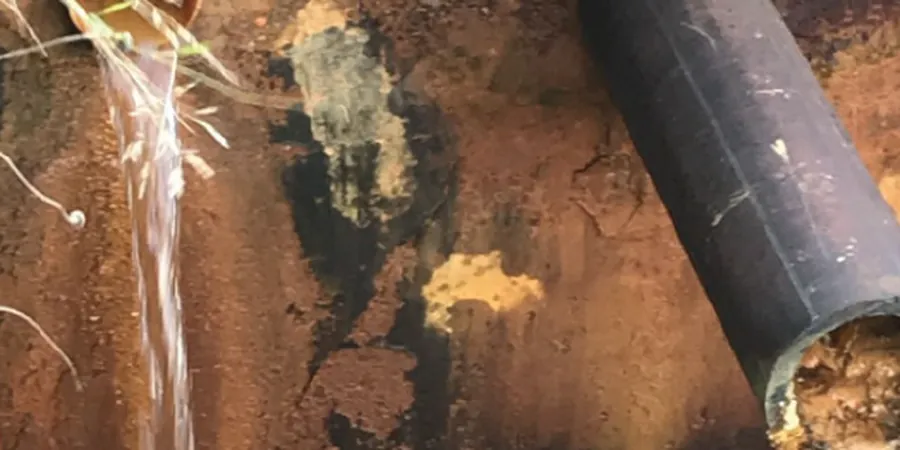
High-plasticity alluvial clays demand drainage systems that accommodate seasonal swelling without losing hydraulic continuity.
Methodology and scope
Local considerations
Albury-Wodonga sits at the foothills of the Great Dividing Range, receiving around 700 mm of rainfall annually. That water has nowhere to go in the flat low-lying suburbs. Without a site-specific geotechnical drainage design, seasonal saturation can trigger differential heave in slab-on-ground homes and lateral pressure spikes on retaining walls. We have seen cases where ponding behind a 2-metre wall produced hydrostatic loads exceeding the wall's structural capacity. Our drainage layouts account for both groundwater seepage and surface runoff using weep holes, trench drains, and permeable blankets designed to the local clay's actual flow rate.
Applicable standards
AS 4678-2002, AS 1726-2017, AS/NZS 1170.2
Associated technical services
Subsurface Drainage Design
Perforated pipe systems with geotextile wrap and granular filter, sized to the measured hydraulic conductivity of the site. We calculate pipe spacing and invert levels to keep the water table at least 0.5 m below formation level.
Surface Water Management
Swales, catch drains, and lined channels designed to convey runoff away from foundations and retaining walls. We integrate these with the existing stormwater network in Albury-Wodonga to avoid overloading local infrastructure.
Dewatering Strategy
Temporary dewatering plans for excavations below the water table. We specify wellpoints or sump pumping rates based on the clay's low permeability, and include settlement monitoring to protect adjacent properties.
Typical parameters
Frequently asked questions
How does the high water table in Albury-Wodonga affect drainage design?
A shallow water table means the drainage system must work year-round, not just during storms. We design for continuous seepage by specifying pipe gradients of at least 0.5 % and using filter fabrics that prevent clogging from the local fine silts.
What is the typical cost range for a geotechnical drainage design in this region?
For a standard residential or small commercial project the fee ranges between AU$1.120 and AU$4.360. The final price depends on site size, number of boreholes, and complexity of the groundwater model required.
Do swelling clays require special drainage details?
Yes. High-PI clays need flexible pipe joints and thicker granular envelopes to accommodate ground movement without breaking hydraulic continuity. We also specify non-woven geotextiles that allow water passage while preventing soil migration.
How long does a typical drainage design study take?
A straightforward design with two boreholes and basic infiltration testing takes 10 to 15 working days. Larger sites with multiple retaining walls or deep excavations can extend to 25 days including reporting and peer review.