The soil profile around Albury-Wodonga varies sharply between the floodplains of the Murray River and the granitic slopes of the surrounding hills. That contrast directly affects retaining wall design — what works on the river flats will not hold on a decomposed granite cut. Our team has logged dozens of test pits across the twin cities, from Lavington to West Wodonga, and we know exactly where the ground conditions shift. Before we start any retaining wall design, we run a classification of soils to identify expansive clays or collapsible sands. That first step saves weeks of rework later.
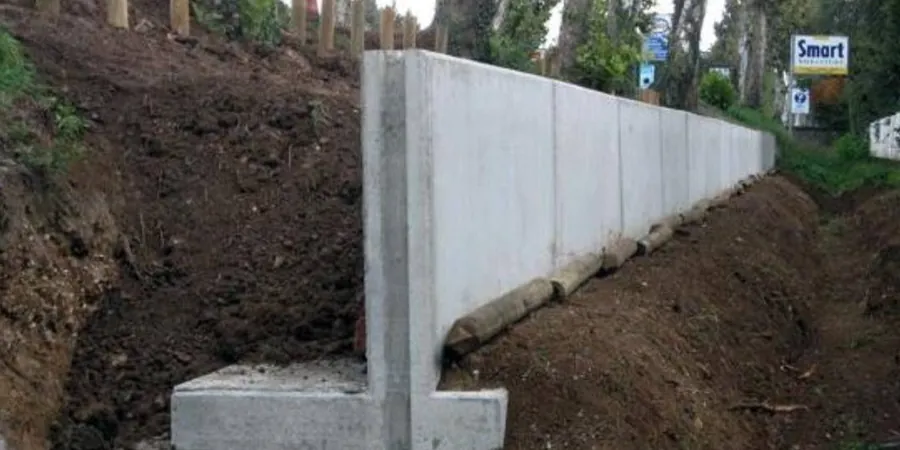
Reactive clays in Albury-Wodonga can swell 40 mm per season — retaining walls that ignore that movement crack within two years.
Methodology and scope
- Site-specific classification per AS 1726-2017 to map clay reactivity (from H to E class)
- Shear strength testing on undisturbed samples via direct shear test to set drained friction angles
- Sliding and overturning checks with partial factors from AS 4678
Local considerations
The biggest mistake contractors make in Albury-Wodonga is assuming one wall design fits the whole site. A wall near the Murray River floodplain sits on soft alluvial clay with low undrained shear strength, while 500 metres away on a granite ridge the soil is dense but prone to erosion along fissures. Without proper site investigation, the wall either slides forward during wet winters or cracks from clay swelling in dry summers. We have seen retaining walls tilt 100 mm in two years simply because the drainage aggregate was omitted. That is why every retaining wall design we deliver includes a written risk statement tied to the actual soil profile.
Applicable standards
AS 4678-2002: Earth-retaining structures, AS 1726-2017: Geotechnical site investigations, AS/NZS 1170.2: Structural design actions — wind loads
Associated technical services
Site investigation and soil logging
Test pits and boreholes to map clay reactivity, groundwater level, and fill thickness across the property.
Shear strength testing
Direct shear and triaxial tests on undisturbed samples to determine drained and undrained parameters for wall stability.
Drainage and groundwater analysis
Permeability tests and piezometer installation to design weep holes, drainage blankets, and filter layers behind the wall.
Structural wall verification
Overturning, sliding, and bearing capacity checks per AS 4678 with partial factors for the actual soil conditions.
Typical parameters
Frequently asked questions
What soil conditions most affect retaining wall design in Albury-Wodonga?
Reactive clays with high shrink-swell potential (H to E class) are the main concern. These clays can cause lateral pressure changes of 30% between dry and wet seasons. Decomposed granite slopes also present erosion and raveling issues behind the wall.
How long does a typical retaining wall design take for a residential site in Albury-Wodonga?
For a standard 1.5 m wall on a single residential lot, we complete the site investigation and design report within 10 to 14 working days. Larger commercial walls or sites with groundwater require 3 to 4 weeks.
Do I need a geotechnical report before building a retaining wall on my Albury-Wodonga property?
Albury City Council and Wodonga Council both require a geotechnical report for walls over 1.0 m in height. Even for shorter walls, a report protects you from unexpected soil movement and drainage issues.
What is the typical cost range for retaining wall design and soil testing in Albury-Wodonga?
For a complete package including site investigation, lab testing, and a certified design report, costs range between AU$1.710 and AU$7.420 depending on wall length, soil variability, and groundwater depth. We provide a fixed quote after the site walkover.
Can you design a retaining wall on a steep granite slope in West Albury?
Yes. We have designed multiple walls on the decomposed granite slopes of West Albury and the hills around Wodonga. The key is using drained friction angles from direct shear tests on the actual granite gravel, not textbook values.