The Murray River floodplain gives Albury-Wodonga a complex mosaic of alluvial clays, sands, and gravels with abrupt lateral changes. Differential settlement becomes a real risk when one footing sits on stiff clay and another on loose sand only metres away. We quantify these contrasts through boreholes, SPT, and undisturbed sampling, combined with consolidation testing under AS 1289.6.3.1. Before any foundation design, we perform a detailed classification of soils to map the variability across your site and then run settlement calculations using Casagrande's method for each distinct layer identified.
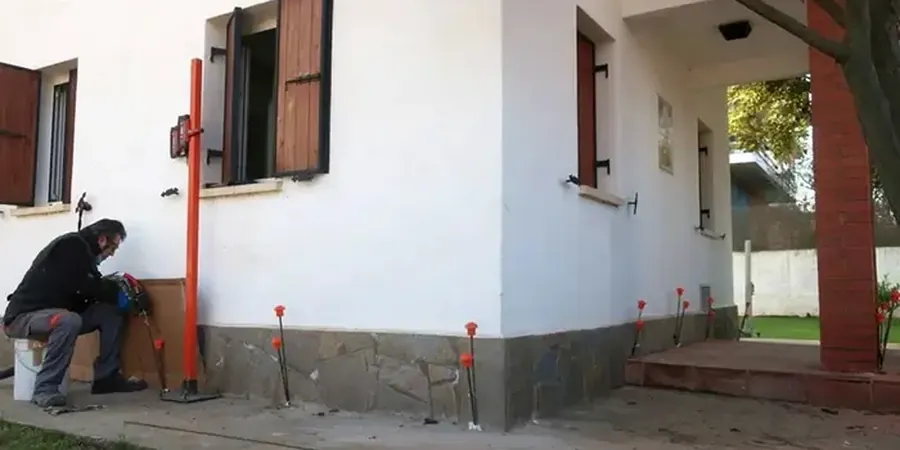
A 10 mm difference in settlement between adjacent columns can crack a reinforced concrete slab beyond repair.
Methodology and scope
- Desk study of local borehole records from the Murray-Darling Basin Authority
- Field investigation with SPT and undisturbed tube sampling at intervals no greater than 1.5 metres
- Laboratory oedometer tests determining compression index (Cc) and recompression index (Cr) for each stratum
Local considerations
The dual-city climate brings wet winters and dry summers, causing seasonal moisture changes in the expansive clays found near Lavington and East Albury. These clays swell when wet and shrink when dry, producing cyclic heave and settlement that differential settlement analysis must capture. Ignoring the shrink-swell potential can lead to repeated cracking in slab-on-ground houses. We address this by running multiple oedometer tests at field moisture content and at saturation, then model the worst-case scenario for both summer and winter conditions.
Applicable standards
AS 1289.6.3.1:2015 (Consolidation test), AS 1289.6.2.1:2015 (Swelling pressure test), AS 2870:2011 (Residential slabs and footings)
Associated technical services
Consolidation Testing Program
Oedometer tests on undisturbed samples from each major stratum in Albury-Wodonga, determining Cc, Cr, and pre-consolidation pressure. Results feed directly into settlement calculations for each footing location.
Settlement Modelling & Reporting
Finite element analysis using Plaxis 2D or Settle3D to predict immediate and long-term differential movement. Report includes isopach maps of settlement across the site and recommendations for foundation type or ground improvement.
Typical parameters
Frequently asked questions
What is differential settlement and why is it a problem in Albury-Wodonga?
Differential settlement is the uneven vertical movement between different parts of a structure. In Albury-Wodonga the alluvial soils of the Murray River floodplain vary dramatically within short distances — one footing may rest on stiff clay while another sits on loose sand. This uneven movement can crack walls, distort frames, and damage services. Our analysis identifies the risk zones before construction.
How much does a differential settlement analysis cost in Albury-Wodonga?
For a typical residential or small commercial project in Albury-Wodonga, expect a cost range between AU$1,000 and AU$3,010. This includes fieldwork, laboratory consolidation tests, and a detailed settlement report. Larger sites or those requiring deeper boreholes will be at the upper end. Contact us for a project-specific quote.
What standards govern your settlement analysis in Australia?
Our work follows AS 1289.6.3.1 for the consolidation test procedure and AS 2870 for residential slab and footing design. For commercial structures we also reference the Australian Standard for earth retaining structures (AS 4678) where applicable. All calculations are performed in accordance with the principles of Terzaghi's one-dimensional consolidation theory.
Can you do the analysis on an existing building showing cracks?
Yes. We can perform a forensic differential settlement analysis on existing structures in Albury-Wodonga. This involves coring through the slab, installing settlement pins, and taking undisturbed samples from beneath the footing. We then model the historical settlement and recommend remedial measures such as underpinning or soil grouting.